Computing Legacies: Digital Cultures of Simulation
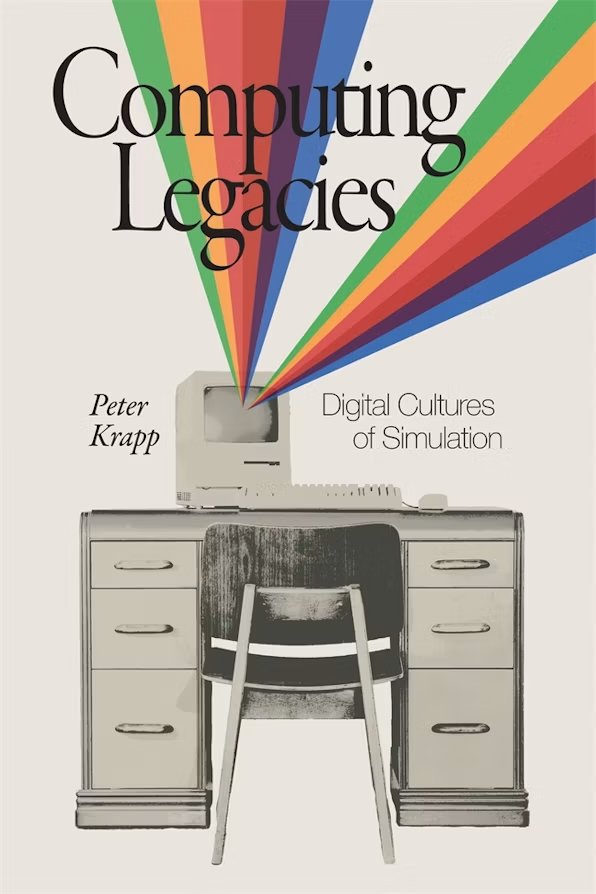
Peter Krapp
📘 MIT Press (2024)
Computing Legacies
A media history of simulation that contextualizes our digital heritage and the history of computing.
A media history of simulation that contextualizes our digital heritage and the history of computing.
A media history of simulation that contextualizes our digital heritage and the history of computing.
Computing Legacies: Digital Cultures of Simulation explores a media history of simulation to excavate three salient aspects of digital culture. It profiles simulation as cultural technique, enabling symbolic work and foregrounding hypothetical literacy; it positions simulation as crucial for the preservation of cultural memory, where modeling, emulation, and serious play are constitutive in how we relate to our mediated history. And despite suggestions that we may already live in a simulation, it interrogates how simulation can serve as critique of the computer age.
In tracing our digital heritage, Computing Legacies elucidates inflection points where quantitative data becomes tractable for qualitative evaluations: modeling epidemics for scientific study or entertainment, emulating older devices, turning numerical calculations into music, conducting espionage in virtual worlds, and gamifying higher education. Simulation, Peter Krapp demonstrates in this book, is pivotal not only to high-tech research and to archives, museums, and the preservation of digital culture - but also to our understanding of what it is to live and work under the technical conditions of computing.
Core themes woven through every chapter.
What the theoretical framing of computing reveals about technical history and institutional memory.
Prehistories of simulation, and how they fostered an aptitude for hypothetical literacy and the rise of media.
In the 8-bit sounds of retro-gaming, vintage hardware designs echo in creative uses of extant chips.
When pervasive clandestine and covert surveillance of online games and virtual worlds was revealed, what reactions did this prompt from from around the world?
When does the computer get into the museum, how does the museum get into the computer? Sources and histories not found in any other computing history.
In the context of online education and rampant gamification it is no surprise to see higher education administration modeled in a simulation game...
The following passage is drawn from the opening chapter.
“The digital heritage,” UNESCO points out, “embraces cultural, educational, scientific and administrative resources.” As simple as it may seem, such a statement has programmatic implications, and the aim of this book is to unfold a series of them. The following chapters discuss cultural, educational, scientific, and administrative cases where our computing legacies revolve around techniques of simulation. Cultural organizations (libraries, museums, archives, universities) play important roles in preserving not just knowledge but access to it, understanding of it, and context for it. The UNESCO charter on digital heritage emphasizes access but also warns about privacy, calls for a balance between the rights of creators and the interests of the public, outlines measures guarding against loss, and foregrounds continuity in digital heritage. These values are hardly controversial, though they may prove incompatible in practice. Trying to respond to that broad scope, this take on digital heritage therefore sets out to look at how simulation plays a pivotal role in computer museums, university administration, computer music, and online games.
Endorsed by leading voices in history of computing, media studies, and beyond.
"Peter Krapp’s 'Computing Legacies: Digital Cultures of Simulation' offers a timely, thought-provoking lens on digital simulation as an epistemic and cultural technique. [...] As simulation increasingly blurs the lines between cultural artifacts and scientific instruments, especially through opaque AI models, Krapp’s work gains even more relevance."
"Computing Legacies offers critical tools for scholars to further engage with simulation as a site for digital culture’s interpretation, contestation, and reimagination. [...] Especially promising is his emphasis on the potential for simulation to function as critique, not merely reflecting the logic of computational culture but challenging its assumptions. Krapp locates this possibility for critique through his careful engagement with history and memory"
"In 'Computing Legacies: Digital Cultures of Simulation', Peter Krapp describes simulation as a set of cultural techniques, as opposed to a form of static artifactual knowledge, framing these techniques as an emerging field of interest spanning library and information science, policy and national security, and affective interests in the digital arts. [...] Krapp’s writing inspires virtues hard to come by in the digital era: technological attention and patience."
"Computing Legacies deftly interrogates and synthesizes technical computer engineering literature with contemporary media studies scholarship to demonstrate how simulation and emulation are transforming the nature of cultural memory and history."
“Computing Legacies places simulation at the center of digital culture. It is a must-read for anyone interested in what happens when we humans seek help from computers to grasp what is happening around us.”
"This invaluable book illuminates how computers came to be mirror worlds for doubling and troubling our deepest mathematical, scientific, and cultural assumptions about what we know and how we know it."

Available from all major booksellers in print and digital formats
Purchasing from MIT Press directly supports independent academic publishing
Catch Peter Krapp in conversation about this book.
📍 Conference → On Simulation: Uncertain Urban Futures, Zurich, Switzerland
Revise and Resubmit - The Mayukh Show → AI-generated dialogue on YouTube
UCI School of Humanities: Find it here →
Deepak Bhatt Podcast Unveiling Wisdom →
📍 Claremont, CA · noon - 1PM · Watch Here → or on 🎥 YouTube
🎙 Virtual · Listen Now →
📍 Basel University · Invited Lecture → Eikones Forum, Switzerland
📍 Tsinghua Lectures on Science, History, and Philosophy,· Invited Lecture → Tsinghua University, Beijing, China
🌐 ZAZ Bellerive & Accademia di Architettura di Mendrisio, Switzerland → Simulation
Everything journalists, reviewers, and event organizers need — all in one place.